



Read more

Summer Guide: Fat-Tire E-Bikes on Sand, Trails & Gravel – Stay Unstuck
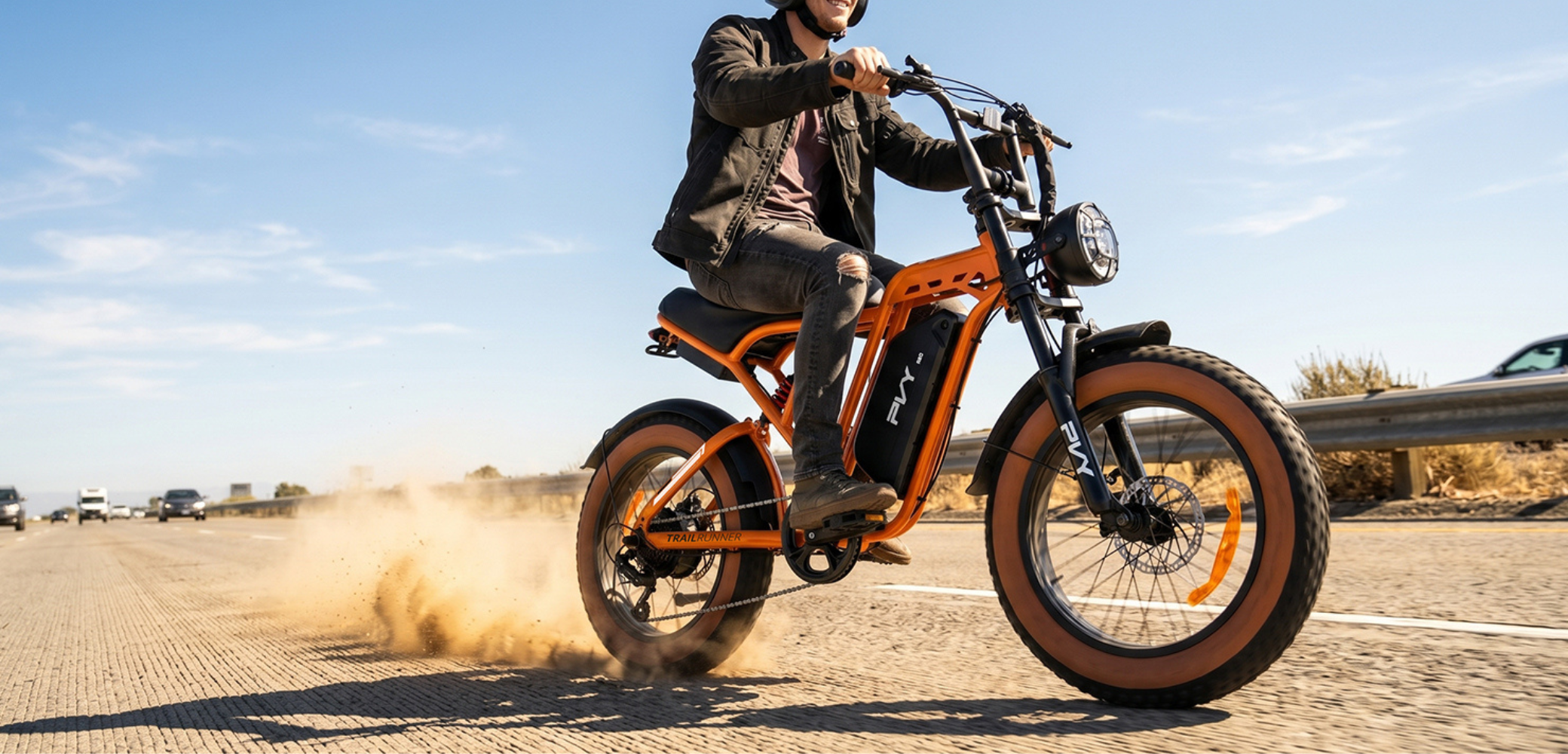
Summer is the season of adventure. The days are long, the trails are dry, and the call of the outdoors is impossible to ignore. For fat-tire e-bike riders, this is the time to explore places that standard bikes simply can't reach — sandy beaches, forest singletrack, gravel backroads, and everything in between.
But here's the thing: having the right bike is only half the battle. Fat tires and a powerful motor give you the potential to tackle rough terrain. Knowing how to use them gives you the confidence to ride without getting stuck, bogged down, or frustrated. This summer guide covers everything you need to know — from tire pressure and body position to braking technique and post-ride care — so you can ride sand, forest trails, and gravel like a pro.
Why Fat Tires Are Your Summer Superpower
Before we dive into techniques, let's quickly recap why fat-tire e-bikes excel off-road. Tires that are 3.5 to 4.8 inches wide provide a larger contact surface, which keeps the bike from sinking into soft sand and offers better grip on uneven terrain. The generous air volume also acts as natural suspension, absorbing bumps, roots, and rocks that would rattle a standard bike.
Combine that with a powerful motor and you've got a machine that can float over sand, climb loose gravel, and roll through forest trails with stability that's hard to match. Models like the PVY Z20 PLUS (1000W motor, 20×4.0" fat tires, dual suspension) and the PVY A20 (100 Nm torque, 20×4.0" tires) are built specifically for this kind of summer adventure.
Now let's get to the riding.
Part 1: Tire Pressure — The Single Most Important Adjustment
If you remember nothing else from this guide, remember this: tire pressure is everything on unpaved surfaces.
Fat tires run at much lower pressures than standard bike tires — typically between 5 and 30 PSI. The exact number depends on your weight, the terrain, and the tire volume. Here's a quick reference:
| Terrain | Recommended Pressure (20×4.0" tires) |
| Pavement / hardpack | 20–25 PSI |
| Mixed terrain / gravel | 15–20 PSI |
| Forest trails / loose dirt | 10–15 PSI |
| Sand (dry / soft) | 5–10 PSI |
The principle is simple: higher pressure = less rolling resistance on hard surfaces. Lower pressure = more traction and "float" on soft surfaces.
For sand, drop your pressure to around 5–10 PSI — or even as low as 4–7 PSI for very dry, powdery sand. This widens the contact patch, allowing the tire to spread out and float over the surface instead of digging in.
For forest trails and gravel, aim for 10–20 PSI depending on how loose the surface is. Lower pressure absorbs roots and rocks; slightly higher pressure keeps you rolling efficiently on firmer sections.
Pro tip: Carry a small digital gauge and a portable pump. You'll want to adjust pressure based on the terrain you encounter throughout your ride.
Part 2: Body Position — You Are the Suspension
On unpaved surfaces, your body is part of the bike's suspension system. How you position yourself affects traction, control, and whether you stay upright.
On Sand and Loose Surfaces
* Shift your weight back when riding through loose sand or gravel. This keeps the front wheel light and prevents it from digging in.
* Stay centered on flat, firm sections. Too far back and you lose front-wheel traction; too far forward and the front wheel plows.
On Forest Trails (Roots, Rocks, and Ruts)
* Stand on the pedals when approaching rough sections. Keep your knees and elbows loose — they act as shock absorbers.
* Lean forward slightly when climbing steep, loose grades to maintain front-wheel traction.
* Look ahead, not down. Your bike follows your eyes. Scan the trail 10–20 feet ahead for obstacles.
On Gravel
* Keep your weight centered over the bike. Gravel can be unpredictable; being centered gives you the best chance to correct slides.
* Relax your grip on the handlebars. A death grip transmits every vibration to your arms and makes steering jerky.

Part 3: Using the Motor Wisely
A fat-tire e-bike's motor is a powerful tool — but on loose surfaces, too much power too fast can spin the rear wheel and leave you stuck.
* On loose climbs (sand or gravel): Use a steady, moderate pedal assist rather than punching the throttle. Sudden power surges dig holes.
* On descents: Consider turning assist down or off. The bike carries momentum well; extra power can make steering feel twitchy.
* On flat dirt or gravel: Mid-level assist lets you cruise comfortably without overwhelming traction.
* Throttle use: Be gentle. Full throttle on loose terrain can cause the rear wheel to spin out.
The goal is smooth, controlled power delivery — not maximum power at all times.
Part 4: Braking — Gentle and Early
Braking on loose surfaces is different from pavement. Sand, gravel, and forest duff offer much less grip.
* Use both brakes but modulate gently. Grabbing a handful of front brake can cause the front wheel to wash out.
* Brake before turns, not during. Slow to a comfortable speed, then release the brakes as you enter the corner.
* On descents, feather the brakes intermittently rather than dragging them constantly. This prevents overheating and maintains control.
* On sand, avoid hard braking altogether — it's more effective to slow down by easing off the throttle and letting momentum bleed off naturally.
Part 5: Reading the Terrain
Unpaved surfaces are never uniform. Learning to read the trail ahead is a skill that separates stuck riders from smooth riders.
* Sand: Look for darker, damp sand near the waterline — it's much more compact and easier to ride. Dry, powdery sand is the hardest; keep momentum high and avoid sudden turns.
* Forest trails: Watch for roots, loose rocks, and muddy patches. Pick the cleanest line. On singletrack, the center is often the most worn; the edges may be softer but offer better grip.
* Gravel: Loose gravel on top of hardpack is the most challenging. Look for tire tracks where other riders have packed the surface. Avoid the deep loose stuff in the center of the road.
Part 6: Summer-Specific Challenges
Summer brings its own set of conditions that affect fat-tire e-bike riding.
Heat and Tire Pressure
Hot pavement and direct sun can raise tire pressure by 2–5 PSI. Check pressure when tires are cold (before riding or after the bike has been in the shade). If you're riding on hot asphalt between trail sections, consider a slight pressure drop to maintain grip.
Sand and Salt (Beach Riding)
Beach riding is incredible — but salt and sand are brutal on bike components. After every beach ride:
* Rinse off salt and sand with fresh water
* Dry the bike completely before storing to prevent rust
* Re-lubricate the chain — sand and salt strip lubrication quickly
* Check electrical components for any signs of corrosion
Battery Life
Sand and soft surfaces demand more power from your motor. Plan your rides accordingly. A 48V battery with decent capacity (like the 48V 16.5Ah found on PVY models) will handle most summer adventures, but don't push your luck on long beach expeditions without a charging plan.

Part 7: Pre-Ride Checklist for Summer Off-Road
Before you head out, run through this quick check:
* Tire pressure adjusted for the terrain you'll ride
* Battery fully charged (or enough for your planned distance)
* Brakes tested — especially important on heavier e-bikes
* Chain lubricated
* Suspension (if equipped) adjusted for your weight and terrain
* Water and snacks — summer rides are longer and more strenuous
* Phone and basic tools — just in case
Part 8: Post-Ride Care
A little maintenance after each ride keeps your fat-tire e-bike running strong all summer.
* Wipe down the frame — especially around the motor, battery mount, and display
* Clean the tires — remove embedded debris that could cause punctures
* Check for loose bolts — vibration from rough terrain can loosen things over time
* Store the battery indoors if temperatures are extreme (over 95°F / 35°C)
Final Thought: Summer Is Made for Exploration
Fat-tire e-bikes are more than a trend. They're a gateway to places you've always wanted to go — beaches at sunrise, forest trails at golden hour, gravel roads that lead to nowhere in particular. With the right pressure, the right position, and a little practice, you can ride those places without getting stuck.
So pump up (or down), charge that battery, and point your fat tires toward the horizon. Summer is waiting.